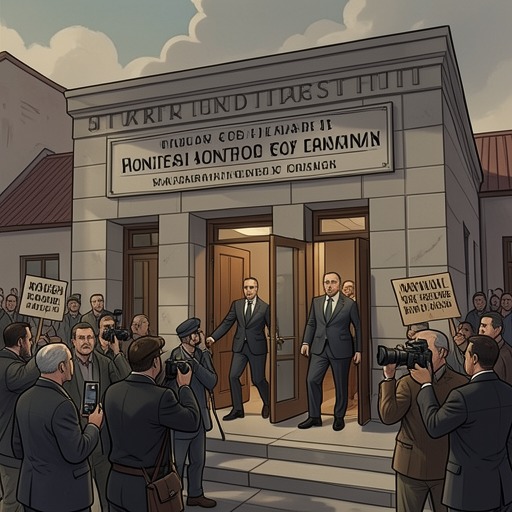
Yue
The Killing RoomYue, the Procurator General, becomes a forceful presence in Li Yan’s investigation not by taking it over but by insisting that Li deliver a rapid, politically acceptable result. Their confrontations expose the gulf between the investigation’s uncertain evidence and the demands placed on it, while showing that Yue’s authority can be challenged when Li makes the cost of interference explicit.
Position and First Appearance
Yue’s first appearance at the detectives’ briefing is itself a measure of the case’s political importance. The room is crowded, hot, smoky, and tense; Section Chief Huang presides while Li begins reporting on Margaret Campbell’s re-examination of the body found in Beijing. Then Yue arrives in uniform. His attendance is so unusual that the detectives react with an almost audible intake of breath. He closes the door, takes a chair beside Huang, folds his arms, and fixes his attention on Li. His grim expression makes the briefing feel less like an ordinary review than a scrutiny of the investigation’s progress.
Li gives the team the evidence accumulated so far: the autopsy conclusions, four identifications, the possibility that dental X-rays might identify another victim, and the inquiries into Jiang Baofu, including interviews with his tutors and apartment-block caretaker and a search of his apartment. The detectives agree that Jiang is deeply suspicious, but they have no evidence connecting him to the killings. Li’s immediate hope is to establish whether Jiang was in Beijing when the young woman there was murdered. Yue listens as the investigation’s central difficulty takes shape: suspicion is extensive, proof is not.
Pressure for Results
After the briefing, Yue waits until the room has emptied before confronting Li across the table. He reduces five days of work by Section Two to four identifications, a sketchy description of a man with a hare-lip, and a medical student who cannot be tied to the crime. The terseness of that inventory is part of the pressure: the lack of a breakthrough is presented as an institutional failure, not merely as an unresolved investigative problem.
Li answers that investigations take time. Yue counters that time is against him. The Mayor had asked Li to lead the case expecting a speedy conclusion, Yue says, while Li’s public contradiction of the press statement issued after the bodies were discovered has embarrassed the administration. With no credible alternative account yet established, silence is also attracting speculation in the American media, and the Mayor is unhappy. Yue thus links investigative delay to political reputation and public scrutiny. His demand is not simply that Li keep working, but that the work soon produce a result capable of answering pressures beyond the evidence room.
Li recognizes the assignment as a poisoned chalice and proposes that Yue’s department take over. The suggestion turns the pressure back on its source: if the investigation is so compromised, the senior official can assume responsibility for it. Yue understands the maneuver and does not accept. Instead, he invokes the Mayor and the policy adviser’s decision to trust Li and warns that Li must not prove that confidence misplaced. Yue leaves with his dignity intact, but the exchange has made an enemy of him in Li’s eyes. His controlled exit does not dissolve the conflict; it makes clear that the demand for progress will continue without a transfer of responsibility.
Authority and Dispute over Cui Feng
Yue is also present when Li is summoned to meet the Commissioner of Police about his conduct toward Cui Feng. In the Commissioner’s office, Yue stands by the window holding papers but does not refer to them or intervene as the Commissioner criticizes Li for disregarding Section Chief Huang’s advice. The scene places Yue within the senior official circle overseeing Li, but gives him the role of silent witness rather than principal speaker.
The sharper dispute comes later, after Xinxin has been kidnapped and Li, exhausted by hours of interrogation, demands a search warrant for Cui’s premises. Yue acknowledges the strain of the kidnapping and says he will overlook Li’s behavior, but refuses the warrant. In his view, Li has no evidence against Cui or his employees; the case rests on the account of a medical student who admits to cutting up and burying the bodies. Yue argues that even if the student’s account is believed, a large organization could have carried out the procedures without Cui’s knowledge. He also entertains the possibility that the student himself abducted and mutilated the women, perhaps in an operating room at the Medical University after hours.
Li counters with the physical and practical circumstances of the Shanghai World Clinic: a converted villa with two small operating theatres and only a handful of special-care beds, one of which houses Cui’s office. Li argues that more than forty women could not have been surgically murdered there without Cui knowing. He also points to a forensic discrepancy: twine taken from the university did not match the twine used to sew up the women buried at Lujiazui. Yue dismisses the mismatch as compatible with a different ball of twine and maintains that nothing connects Cui to the crimes beyond the student’s claims. The exchange sets competing standards of inference against each other: Li treats the clinic’s scale and the material evidence as grounds to investigate Cui, while Yue insists that suspicion cannot justify a search.
The Confrontation’s Limit
The balance shifts when Section Chief Huang reports that his dying wife is being sent home. The news briefly chastens both men, but Li’s priority remains finding Xinxin before her kidnappers can harm her. He tells Yue that he will take detectives and forensic officers to the clinic with or without a warrant. If forced to proceed without one, Li threatens to charge Yue with attempting to pervert the course of justice and to begin corruption investigations against him.
Yue visibly pales. Li then expands the threat beyond Shanghai, saying he will take the matter to the highest authorities in Beijing and invoking his record of bringing charges in major corruption cases. Yue responds with anger, warning that if Li finds no evidence against Cui, this will be the last time he threatens anyone. The scene ends with Li asking whether that means he will get the warrant; the supplied episode does not establish Yue’s answer. His arc in these encounters therefore ends not in a settled victory for either man, but at the point where institutional authority has been openly tested. Yue begins by measuring Li against political expectations and refusing to let weak evidence authorize a search. Under Li’s counter-threat, however, his control is no longer unquestioned: the investigation’s next move has become a contest over who will bear responsibility for acting, and for refusing to act.